

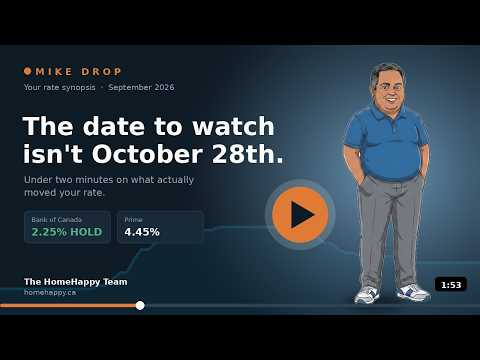




Hey, it’s Mike from the HomeHappy Team here with your rate synopsis for September 2026. As expected, the Bank of Canada decided to make no change today. They’re under a lot of pressure from differing forces and chose just to stand on the sidelines, as they have since October of 2025. One of the factors that affects things is inflation, and we have had an increase in inflation, particularly since the Iran situation occurred back in March, and we haven’t had a solution to that, obviously. It keeps starting up again, and that has impacted all the world for inflation. We’ve all pretty well gone up, as you can see. However, it hasn’t got as high as some of the media expected, so it hasn’t affected the Bank of Canada in terms of their decision-making. Fixed rates have been impacted because they’re directly part of the market. It’s how the market moves based on the price of oil, which has gone up, and that’s caused bond yields both in the U.S. and in Canada to go up, and those are directly what affects the fixed rates. So they have climbed somewhat, as you can see, and that’s making an impact on what we could lock into right now. The next date to watch is not actually October 28th, when the Bank of Canada meets again. It’s actually September 16th, when the U.S. Fed is getting together, and a lot of people feel they’re going to make an increase in their Fed rate. So that’ll be interesting to watch. And with all of this, like anything, nobody can predict the future. It’s all guessing. Take a look at these stats from 2021, when the Bank of Canada told us all that they weren’t going to raise prime, and even just since last year, what the predictions were compared to what’s actually happened. So with everything, it’s always about you and your situation, not about what’s going on in the world. We can’t control that. So if you’d like a custom personal review of your situation, that’s what we’re here for. Thanks very much.
Mike’s September 2026 rate synopsis: the Bank of Canada held again, as it has since October 2025, but higher oil prices pushed bond yields and fixed mortgage rates up. What to watch next, and why your own plan matters more than anyone’s forecast.
Ever wondered what a Beacon score is? It’s simply another name for your credit score, a vital number for your financial health. Ranging from 300 to 900, lenders use it to gauge your creditworthiness. It reflects factors like payment history, credit utilization, account age and more. Why care? Scores above 650 are considered good, and 750-plus is excellent. Higher scores mean easier approvals and lower interest rates. A strong score can save thousands on interest and help you secure a home. It shows lenders you’re reliable, making you a safer bet. Build your score, and check your credit report regularly.
Your Beacon score is your credit score, from 300 to 900, and lenders use it to judge your creditworthiness. The HomeHappy Team explains what goes into it, what counts as good, and why a stronger score means easier mortgage approvals and better rates.
Mike: Hey everybody, it’s Mike from the HomeHappy Team. I’m here with Dallas and Ian. Guys, introduce yourselves.
Dallas: Yeah, Dallas Crick with Hilbert & Crick Real Estate, out of Royal LePage.
Ian: Hey, and I’m Ian Flower with Okanagan Inspections, based here in Kelowna.
Mike: Great. Thanks for joining us, guys. It’s a topic that comes up with a lot of people: do I need an inspection? What is an inspection? Is an inspection an appraisal? All those things. So Ian, why don’t we start with you? Tell us a bit about what you do and how you got into it.
Ian: Yeah, absolutely. I’ll start with a bit of my background, coming from construction and trades: understanding homes, building homes, renovating, tearing down old and putting up new. So we got to see homes at all different stages, from new builds to tear-downs, and what’s been done wrong and what’s been done right. As I gained experience and age, I also got aches and pains in the body, and it was a natural transition to go into the inspection world and transfer that knowledge. Why you want a home inspection is understanding the home and its current condition so you can make educated decisions. It’s one of the largest investments people make in their lifetime, whether that’s a residential or commercial property. So it’s understanding that home and its current condition so you can work with great agents like Dallas to make sure you’re getting what you’re paying for.
Mike: So you never have to crawl in crawl spaces anymore?
Ian: Yeah. I’m a big guy, but you’d be shocked at the attic spaces and crawl spaces I get into. During a walk-through, you get that half hour to walk through the home and see if you like it, if that’s what you want to make your forever home. As an inspector, we’re not looking at the paint colours or whether your couch is going to fit. We’re in for two and a half hours, unobstructed. We’re on the roof, we’re in those attics, we’re in those crawl spaces. We’re looking at the mechanicals, the furnaces, the air conditioning, all the stuff you’re not really looking at, to make sure there are no hidden surprises for you.
Mike: Fantastic. Dallas, what does it mean to you when you’re helping clients and you can bring Ian in to work with you?
Dallas: To me, it’s a must. It’s such a small investment for a big investment. To spend that money to get an inspector in there to say, okay, here are some of the concerns we see, it’s priceless.
Mike: Yeah. And you just never know. People aren’t necessarily doing things wrong on purpose; they may just not know they’re supposed to do certain maintenance, or they don’t know what the three people before them in that home did. So it’s not that people are hiding things, it’s that you just don’t know what’s in there. And with your knowledge, I’m sure you see things people don’t even notice, and know that’s a trip wire to the next problem.
Ian: Exactly, Michael. To your point, how often do you get up in your attic? How often do you go down in those crawl spaces? We call it the belly of the beast. That’s where a lot of stuff is happening that you don’t really know about, whether that’s cracks in foundations and leaks, or in the attic. Something common we see is dryer vents or bathroom vents that have fallen off the roof vents, so all that warm, moist air is going into those spaces. Unfortunately, that creates mold and things that aren’t good to be breathing in. So it’s good to get that peace of mind and that overall evaluation.
Mike: It’s no different than going to a doctor every once in a while and getting a physical, especially once you get a little older and things aren’t quite working as they’re meant to. And like you said, Dallas, it’s such a massive investment; to go in blind just seems kind of crazy, doesn’t it?
Dallas: Yeah, it really is. A good story: I was talking to my naturopath. I sold him a home, and we had black mold in the attic. I said, we see it in a lot of homes, and he really laid out how bad this stuff is for you. I started going down the rabbit hole on YouTube, and, okay, yeah, this stuff has got to get cleared out.
Mike: Well, that’s a great introduction. Thank you very much for being here, guys. We’re going to wrap it there, and we’ll come back and talk to Ian more. Thanks for joining.
Ian: All right. Thanks, guys.
Mike talks with home inspector Ian Flower of Okanagan Inspections in Kelowna and Dallas Crick of Hilbert & Crick Real Estate: what a home inspection covers, how it differs from a showing, hidden problems like disconnected vents causing attic mold, and why it’s a small cost on your biggest investment.
Dallas Crick, Hilbert & Crick Real Estate: So when the clients come in to sign, what’s all involved in the conveyancing side of it?
Dani Britto, Acorn Law: Well, that’s a really great question, and a lot of people don’t know. Either it’s their first time buying a home, or it’s been a long time, or they’re buying from out of province, and the process here is very different from Alberta, Ontario or anywhere else. We want to be involved as early as possible, once the offer is accepted. At that stage our role is advice; we want to make sure they have the advice they need. Once conditions come off and the deposit is paid, that’s when we start getting information from various parties. We get mortgage instructions, we get conveyancing instructions from the real estate brokerage, we get tax information and strata information, and then we piece everything together to prepare the closing documents. That’s the transfer, but most importantly from the client’s perspective, it’s the breakdown of the numbers and how this is all going to work. Whereas a mortgage broker talks about a down payment, what we need when you’re signing is the total balance required to close. The closing documents take into account the deposit you’ve already paid, the purchase price, the property transfer tax if that’s applicable, and adjustments for strata fees, property taxes and everything else. The goal is to give that to you a couple of days before closing, so you have time to go to the bank and get a bank draft. A bank draft is similar to a normal cheque, but the bank pulls the money out of your account right away and puts it onto a physical piece of paper. That paper is very important, and it needs to make it to the lawyer’s office. We take it and put it into our trust account. You sign your closing documents, we send everything back to your lender for a final checkmark, and they press a button to send us the money. On the closing date, we get the mortgage money into our trust account, we pair it with the money from the bank draft, and then we have every penny we need to close. At that stage we hit register, the property goes into your name, and we send out a congratulations to you and your realtor. It’s home sweet home!
Dallas Crick of Hilbert & Crick Real Estate asks Dani Britto of Acorn Law what happens on the legal side of a BC purchase: when to involve your lawyer, how the closing documents and balance required to close are prepared, the bank draft, and how the property is registered in your name.
Thinking about a mortgage? You need to know about the stress test. It’s a rule set by Canada’s banking regulator to make sure you can afford your payments even if interest rates go up in the future. It helps protect you and the housing market. So how does it work? When you apply for a mortgage, your lender doesn’t qualify you at the low rate you’re offered. Instead, they use a higher stress test rate. This qualifying rate is the higher of two options: your actual mortgage rate plus 2%, or a fixed benchmark rate. If you pass, meaning you can handle the payments at that higher theoretical rate, you qualify. But because you have to qualify at a higher rate, the biggest impact is that you may be approved for a smaller mortgage amount than you initially expected. The stress test can feel like a hurdle, but it’s really about building a solid financial foundation for your home buying journey. It provides you with a crucial buffer if rates climb later on. The HomeHappy Team can run the numbers and help you find the best strategy to pass the test with confidence.
How the Canadian mortgage stress test works: lenders qualify you at the higher of your contract rate plus 2% or the 5.25% floor, so you may be approved for less than you expected. The HomeHappy Team explains why it exists and how to plan around it.
Dallas: So when it comes to buying, why would you wait for your friends to tell you to buy, or your neighbour, or anyone like that?
Mike: So true. But people do it. They all kind of want everybody to peer pressure them into doing it or something. I don’t know. It’s strange.
Dallas: The lemming effect.
Mike: They all jump together.
Dallas: Yeah, exactly. Then it’s less painful. And you know, if you think about it, when everyone’s buying, why is that the worst time?
Mike: Because then there’s less to pick from, fewer options for you to buy and more pressure. I mean, we remember five years ago when there were five offers on a property, and it’s a terrible feeling. You never know what you’re going to get. You’re having to offer more than you feel comfortable with. That’s a nasty feeling to be in, but people forget that pretty quickly. And here we are where you can literally find a place, take a look at it, even inspect it, or do whatever you want to do, and still nobody else is looking at it. So you’re in a position to hopefully make a fair deal for both you and the person selling. And that’s a healthy place to be in.
Dallas: Yeah, and when it comes time to buying, like being ready, I always say you can’t just go look at puppies, because you’re going to take one home. And when it comes to buying a home, what does it look like to actually be ready?
Mike: Yeah, I mean, it’s a tricky market for this. So you’ve got to have everything ready. If you’re sitting in a condo and you haven’t sold it yet, don’t bother looking at places you might like, because that’s pointless. You’ve got to get that dealt with. Or if you’re not pre-approved or pre-qualified, which is more important, then you’re not ready either, because you don’t know what you can afford or what you want to afford. It’s great to say that you could afford this payment, but what about that payment if rates were to go up, or rates go down? You’ve got to look at the whole scenario of what you can really afford and what you’re comfortable with. Because you and I have both seen too many people who buy a house and are in love with a house, and now they have no life, because they can’t afford a life, because they’re just paying for that mortgage.
Dallas: Yeah, so that leads into the next question. What exactly is the first step?
Mike: The first step is getting to know your numbers. And really, I’m not trying to sell myself. I’m just saying talk to your mortgage broker, whoever it is, whether it’s me or somebody else, but understand exactly where you stand and where you’re comfortable standing. That’s really important. You’re not going to know that until you’ve had somebody go through all the numbers and understand what that means for you and your family and your life.
Dallas: I think another good point, Mike, is when it comes to buying a place, you may approve them up to a certain amount, and that’s not always the best scenario, right? You’re just house poor. All your money is just going into your house.
Mike: Yeah, I have that conversation a lot with clients, and we purposely try not to actually set a really high number. We try to keep it down in a reasonable debt service ratio range, so it’s not the max, because you’ve got to have some room to manoeuvre and be able to go on a vacation if that’s important to you, or whatever it is. But the worst thing is to move into a great house and then feel like you can never do anything with your life again.
Dallas: Exactly.
How to know you’re actually ready to buy, why waiting until everyone else is buying costs you, and why your approval isn’t your budget. Read the full page with the transcript.


Grab a coffee and let’s connect face-to-face from the comfort of your own couch. We’ll jump on a secure video call to review the numbers and build your custom property plan together. Click here to lock in your time.